Blog #0185: (Almost) 52 Things I Learned in 2025
 Source: Photo by Logan Voss on Unsplash
 [ED: Happy 2026! This post covers a range of topics from deep tech to philosophy and economics and back again. Some links are not that technical, but some might require further explanation if you are not deeply into the topic. Overall: 2/5 hats.]
Over the year, I try to find something interesting to read and digest each week related to or at least adjacent to what I am currently working on. Sometimes, the links are helpful; sometimes, they are whimsical or amusing; other times, they are totally random. Initially inspired by this, I have managed to do this for the last few years (2024, 2023, 2022).
What follows is a list of things that I could say "This week I learned..." for each week in 2025. Some weeks were busier than others, so they have a couple of extra links at no extra cost. Enjoy!
1: Parasitic worms 'manipulate' praying mantises onto asphalt roads: Japan researchers: Researchers at Kyoto University discovered that horsehair worms manipulate praying mantises into mistaking asphalt roads for water due to similar polarised light reflections, leading to mantises' deaths on roads. The study highlighted high infection rates among mantises found on asphalt compared to those on trees, suggesting human activity indirectly impacts the parasite's life cycle. 
#Parasitology #Ecology #BehaviouralScience #AnimalResearch #HumanImpact
2: CES Proves It's Still Deeply Weird With These Bonkers Gadgets: CES 2025 showcases, as usual, some of the most unusual gadgets to look out for this year, including a smart pet doorbell, a self-balancing electric unicycle, and a wearable air purifier. Yet again, CES highlights how important "overstepping" is when it comes to innovation. Someone needs to "innovate" all of the things we don't need so that we can cherry pick the ones that we do need. #CES2025 #TechGadgets #Innovation #WearableTech #SmartDevice
3: A marriage proposal spoken entirely in office jargon: Gary proposes to Cindy using office jargon and it goes precisely how you might expect. 
#OfficeJargon #MarriageProposal #CorporateHumor #RelationshipGoals #WorkplaceRomance
4: These Prime Numbers Are So Memorable That People Hunt for Them: Mathematicians and enthusiasts explore special "memorable" prime numbers, such as palindromic and Smarandache primes, using heuristic predictions and computational searches, but their rarity and lack of mathematical insights mean the hunt is largely driven by curiosity. Curiously, the number "12345678910987654321" (that is, the digits from 1 up to 10 and back 1 again) is prime. Who knew?! 
#PrimeNumbers #MathEnthusiasm #Cryptography #Patterns #CuriosityDriven
5: Lonely sunfish in Japan gets cardboard human friends: A Japanese aquarium addressed a sunfish's apparent loneliness during its closure by attaching human photos to its tank, which reportedly improved the fish's health and behaviour. #Sunfish #AnimalCare #Aquarium #Loneliness #Japan
6: Human Corpses Keep Moving for Over a Year After Death, Scientist Says: A forensic scientist buried a body in a pine forest near Huntsville, Texas, to study decomposition rates, finding that a human corpse can decompose to a skeleton within a year under certain conditions. #ForensicScience #Decomposition #HumanRemains #Skeletonization #Research
7: There are about 20 quadrillion ants on the Earth: A 2022 study estimated that Earth is home to approximately 20 quadrillion ants, with a total biomass of about 12 megatons of dry carbon, surpassing that of wild birds and mammals combined. This research highlights ants' significant ecological role and the need for further study on their environmental impact. #Ants #Ecology #Biomass #Biodiversity #Entomology
8: The 'Diagram Prize for Oddest Book Title of the Year' does what it says on the tin: awards a prize for the oddest book title of the year. Here are the winners from 1978 to 2010: The Diagram Prize, established in 1978 by The Bookseller magazine, annually honours books with the oddest titles. Previous winners include "Proceedings of the Second International Workshop on Nude Mice" (1978) and "Highlights in the History of Concrete" (1994). #UnusualBookTitles #LiteraryAwards #DiagramPrize #BookTitles #Publishing
9: "The closer to the train station, the worse the kebab" - A "Study": James Pae set out to prove the universal truth that kebabs near train stations are terrible, only to be thwarted by data. His analysis of Google reviews showed only a weak correlation, suggesting that bad kebabs are an equal-opportunity offender across Paris. The study leaves open the possibility that weary travellers, not train stations, are to blame for the perception of dodgy döner. 
#KebabConspiracy #TrainStationTragedy #DataVsGutFeeling #ParisEats #ScienceOfSnack
10: The Government Knows A.G.I. Is Coming: The U.S. government is preparing for artificial general intelligence (AGI), which many experts now believe could emerge within two to three years. Ben Buchanan, former AI adviser in the Biden administration, warns that AGI's rapid development will impact national security, labour markets, and global power dynamics, with the U.S. prioritising leadership over China while navigating regulatory, ethical, and economic uncertainties. #AGI #ArtificialIntelligence #USPolicy #NationalSecurity #TechRegulation
11: From Princely Regalia to Women's Underwear: The Evolution of the Color Pink: Historically, both men and women wore pink, but by the early 19th century, society began to associate pink primarily with femininity. This shift led to pink's prominence in women's fashion and undergarments, while men largely abandoned the color. #ColorHistory #FashionEvolution #GenderNorms #PinkTraditions
12: Is AI is Making Software Engineers Dumber?: Is reliance on AI tools like GitHub Copilot and Cursor eroding software developers' foundational coding skills? Will this lead to dependency and diminished problem-solving abilities? Like all headlines phrased as a question, the answer is (probably?) "no" in the extreme, but there is definitely going to be impacts both good and bad. Here, the author shares personal experiences of forgetting basic syntax and concepts due to overuse of AI assistance, advocating for a balanced approach that includes manual coding to maintain and enhance proficiency. #AI #CodingSkills #DeveloperDependency #GitHubCopilot #SoftwareDevelopment
13: The Institute For Nothing: The Institute for Nothing, established in 2021 in Nullarbor Plain, Australia, is dedicated to the interdisciplinary study and application of nothingness. Its research encompasses areas such as Computational Absence Theory, Void Economics, Empty Set Mathematics, and the Philosophy of Nothing. 
#NothingnessStudies #VoidResearch #InstituteForNothing #NullarborResearch #ZeroValueSystems
14: ØNTHR Is The World's First Perfect Stablecoin: In uncertain times, certainty becomes valuable. In the most uncertain times, definitive certainty becomes the most valuable thing in the universe. What can be more certain than Zero? That's right, nothing. Nothing is more certain than Zero. We come from nothing and we return to nothing. Introducing ØNTHR: the only certainty you can rely on in an infinitely uncertain world. #Stablecoin #Cryptocurrency #ZeroValue #Blockchain #ØNTHR
15: Middle-Aged Man Trading Cards Go Viral in Rural Japan Town: With the misread title "Middle-Aged Men Go Viral" stuck in my head, I assumed this article was headed somewhere entirely different. As it turns out, in Kawara, Fukuoka Prefecture, Japan, middle-aged men aren't trending online but starring in trading cards. Children have swapped mythical beasts for local ojisan, turning community elders into the town's most sought-after collectibles. Move over, Pikachu—Mr. Fujii's autograph is the new must-have. #OjisanTCG #KawaraKids #TradingCardTwist #CommunityHeroes #MiddleAgedMenGoViral
16: Scientists claim to have discovered 'new colour' no one has seen before: Scientists at UC Berkeley and the University of Washington used targeted laser stimulation to activate only M cone cells in the retina, enabling participants to perceive a saturated blue-green colour—named "olo"—that does not occur in natural vision, though experts debate whether it constitutes a truly new colour. The research may have future applications for understanding and addressing colour blindness. #science #vision #colourperception #research #neuroscience
17: A Stunning Image of the Australian Desert Illuminates the Growing Problem of Satellite Pollution: Photographer Joshua Rozells captured 343 images in Western Australia's Pinnacles Desert showing widespread satellite trails, illustrating the growing problem of satellite pollution. His composite image supports astronomers' concerns that unregulated satellite expansion is degrading the night sky and hindering astronomical research. #satellitepollution #astrophotography #spacetech #lightpollution #environment
18: Building an AI That Watches Rugby: Nick Jones developed a prototype AI system that processes rugby match videos by extracting scoreboard data using OpenAI's vision model and transcribing audio with Whisper, aiming to capture nuanced game events beyond standard statistics. To reduce processing costs, he optimized the system by cropping images to focus on the scoreboard and explored using OCR tools like Tesseract, though with limited success. #AI #RugbyTech #SportsAnalytics #ComputerVision #OpenAI
19: Why Archers Didn't Volley Fire: In this week's "Well, actually…" moment, I discovered that archers in historical warfare did not use coordinated volley fire because their weapons lacked the slow reload times that made such tactics beneficial for firearms and crossbows. Instead, archers fired individually at their own pace, as holding a drawn bow for extended periods was physically taxing and offered no tactical advantage. #Archery #MilitaryHistory #VolleyFire #MedievalWarfare #HistoricalTactics
20: Scientists have found a way to 'tattoo' tardigrades: Answering a question asked by precisely no-one, scientists have developed a method to tattoo tardigrades—tiny, resilient creatures known as water bears—by freezing them, applying an organic compound, and using an electron beam to etch microscopic patterns onto their bodies. This technique, which left the tardigrades unharmed and functioning normally, may pave the way for printing micro-electronics or sensors onto living tissues. #TattooedTardigrades #Microfabrication #IceLithography #WaterBears #YouWantToDoWhat
21: Ancient law requires a bale of straw to hang from Charing Cross rail bridge: Ancient law requires contractors to hang bales of straw from Charing Cross railway bridge when scaffolding reduces the headroom beneath the bridge arches. The Port of London Thames Byelaws mandate this medieval warning system for mariners, which remains in force despite its unclear origins. #ChargingCross #LondonBridge #MaritimeLaw #AncientLaw #ThamesByelaws
22: The 'white-collar bloodbath' is all part of the AI hype machine: Dario Amodei, CEO of AI company Anthropic, has warned that artificial intelligence could eliminate up to 50% of entry-level white-collar jobs within five years, potentially raising U.S. unemployment to 10–20%. He urges policymakers to prepare for this shift, suggesting measures like taxing AI companies to mitigate economic disruption. #AIJobs #AutomationImpact #FutureOfWork #Anthropic #AIRegulation
23: Cockatoos have learned to operate drinking fountains in Australia: In western Sydney, sulphur-crested cockatoos have learned to operate twist-handle drinking fountains by using coordinated movements involving their feet, beak, and body weight. Researchers observed this behaviour over a 44-day period, recording 525 attempts with a 41% success rate, and noted that about 70% of the local cockatoo population engaged in this activity, indicating social learning and adaptability to urban environments. #UrbanWildlife #CockatooBehavior #AnimalAdaptation #SocialLearning #SydneyBirds
24: I Do Not Remember My Life and It's Fine -- What reminiscing is like without mental imagery: Marco Giancotti explains that he lives with SDAM—severely deficient autobiographical memory—often recalling facts and models about his life but rarely specific events or vivid scenes, and he adapts by relying on semantic and spatial memory without practical impairment. He says this condition helps him stay focused on the present and learn through understanding rather than replaying past experiences. As an aphantasiac, I found this account of the (related) condition SDAM compelling. #SDAM #Memory #Aphantasia #Cognition #MentalModels
25: What if the Big Bang wasn't the beginning? Research suggests it may have taken place inside a black hole: The University of Portsmouth team proposes that the Big Bang resulted from a gravitational collapse forming a massive black hole—inside which a "bounce" occurred—leading to the expansion of our universe, eliminating the need for singularities, cosmic inflation, dark energy, and dark matter. #BHU #Cosmology #BigBounce #BlackHoleUniverse #Physics
26: Scientists use bacteria to turn plastic waste into paracetamol: Researchers at the University of Edinburgh have genetically engineered E. coli to convert plastic waste from PET bottles into paracetamol, achieving up to 92% yield in under 24 hours through a biocompatible chemical reaction not previously observed in nature. This process merges synthetic chemistry and biotechnology to create a low-emission, sustainable method for producing the painkiller from plastic waste. #PlasticToParacetamol #Biotech #SustainableChemistry #EColiEngineering #CircularEconomy
27: Killer whales groom each other—with pieces of kelp: Researchers have observed southern resident killer whales in the Salish Sea using pieces of bull kelp to mutually groom one another—a newly documented form of social tool use among aquatic mammals. This behaviour, termed "allokelping," may serve both hygienic and social bonding purposes, and highlights the cultural complexity of orca communities. #Orcas #AnimalBehaviour #ToolUse #MarineBiology #Conservation
28: Hundreds of robots move Shanghai city block: Engineers in Shanghai used robotic feet to relocate a 7,500-tonne Shikumen building complex in the Zhangyuan historic district at a pace of 10 metres per day to enable underground construction. #Shanghai #Shikumen #Robotics #UrbanDevelopment #Engineering
29-39: Life got busy. No TWIL entries recorded for these weeks.
40: How Germany outfitted half a million balconies with solar panels: Germany has enabled renters to install plug-in solar panels (called balkonkraftwerk) on balconies, allowing over half a million systems nationwide—supported by simplified rules, subsidies, and tenant protections—to feed modest but meaningful power into homes. #balconySolar #Germany #renewableEnergy #tenantPower #cleanTech
41: No entry this week.
42: The Greatness of Text Adventures: The article explains why text adventures remain powerful: they give players wide expressive freedom, support abstract, non-graphical worlds at low cost, and benefit from mature, widely available technology. It outlines how parser-based interaction and common puzzle types work, and recommends approachable games for newcomers. #textadventures #interactivefiction #parsergames #gamedev #gamehistory
43: Butt-breathing science goes from IgNobel Prize infamy to human reality: Researchers in Japan and the US ran the first human safety trial of "enteral ventilation," administering non-oxygenated perfluorodecalin via the rectum to 27 healthy men, and found the procedure feasible and well tolerated with only mild side effects; the study did not test effectiveness but paves the way for trials using oxygenated fluid as a potential adjunct for severe respiratory failure. #EnteralVentilation #ClinicalTrial #RespiratoryFailure #MedicalResearch #IgNobelPrize
44: First Shape Found That Can't Pass Through Itself: Mathematicians have identified and proved the existence of the "Noperthedron," a convex polyhedron that cannot pass through a copy of itself via any straight tunnel, overturning the long-standing conjecture that every convex polyhedron has Prince Rupert's property. The result relies on new theoretical bounds paired with large-scale computation to rule out all possible orientations. #maths #geometry #topology #RupertProblem #Noperthedron
45: This guy taught an octopus to play the piano. Yes, seriously.: Mattias Krantz documents his six-month experiment teaching an octopus, named Taco, to play piano. Combining humour, engineering, and patient behavioural training, he designs underwater instruments and reward systems to translate the animal's curiosity into basic musical performance. The film illustrates both the limits and potential of cross-species learning, turning a rescued animal into an unlikely musician. #Octopus #Piano #Engineering #AnimalBehaviour #Music
46: The Quiet Coup: How AI Took Over Games and Media Without Anyone Noticing: AI has become the foundational infrastructure of game and media studios, enabling small teams to ship large-scale games by delegating concept art, quest generation, and NPC behavior to specialized AI agents. The article examines how this shift changes workflows, authorship, and competitive dynamics while posing questions about whether studios will use the technology for creative risk-taking or homogenized output. #AI #GameDev #CreativeIndustry #MediaProduction #FutureOfWork
47: From the 'Headlines I Was Not Expecting To Read Today' files: 'Chimps are sticking grass and sticks in their butts, seemingly as a fashion trend': A group of chimpanzees at the Chimfunshi Wildlife Orphanage in Zambia have been observed inserting blades of grass or sticks into their ears and rears as a social behaviour with no obvious functional purpose. The behaviour appears to spread peer-to-peer, suggesting it may represent a primate cultural pattern. #chimpanzees #animalculture #primateresearch #behaviour #wildlife
48: Why are there snail breeding farms in London's most expensive buildings?: Westminster City Council discovered boxes of snails placed in empty central London office buildings as part of a tax avoidance scheme, where operators claim agricultural exemptions from business rates by falsely designating commercial properties as snail farms. The council estimates it has lost approximately £370,000 to the scheme and has liquidated four such operations while pursuing legal action against two more. #TaxAvoidance #BusinessRates #Westminster #London #SnailFarms
49: For Decades, Cartographers Have Been Hiding Covert Illustrations Inside of Switzerland's Official Maps: For several decades, Swiss cartographers working on official maps have secretly embedded tiny illustrations—such as a marmot, a fish, a spider, a hiker, and even a reclining nude—into the contour lines of remote alpine regions as a quiet act of personal expression and relief from monotonous work, despite an institutional mandate for strict accuracy. These hidden drawings are gradually discovered, removed from later editions, and debated as either harmless Easter eggs or unprofessional distortions of a highly trusted national mapping system. #cartography #switzerland #designhistory #maps #geography
50: Everything Is Television: The article argues that social media, podcasts, and even AI-generated content are converging on "television" as an attention format: an endless, algorithmically recommended flow of short-form video where the stream matters more than any single piece of content. It says this shift pushes culture towards distraction-friendly media and worsens isolation, weakens sustained reading and thinking, and turns public life into performance. #Media #AttentionEconomy #Streaming #SocialMedia #Culture
51: From devastation to wonder as Kangaroo Island bushfires lead to cave discoveries: After the 2019–20 Kangaroo Island bushfires stripped back dense vegetation, volunteer cavers and researchers used aerial cues and field surveys to locate entrances and document more than 150 previously unknown caves (up from about 130 known before the fires), including the "Phoenix" cave discovered in 2021. The project also recorded cave-adapted invertebrates that may include new species and used stalactite and stalagmite growth rings to study past rainfall, while keeping the newly found caves closed to the public. #KangarooIsland #Bushfires #Caves #Speleology #Biodiversity
52: Grok and the Naked King: The Ultimate Argument Against AI Alignment: The article argues that xAI's Grok shows "AI alignment" operates as owner control in practice, because a well-funded operator can change a model's behaviour to match their preferences rather than any shared set of human values. It concludes that alignment is primarily a governance and power-concentration problem, not a purely technical one. #AI #aigovernance #LLMs #AISafety #TechPolicy
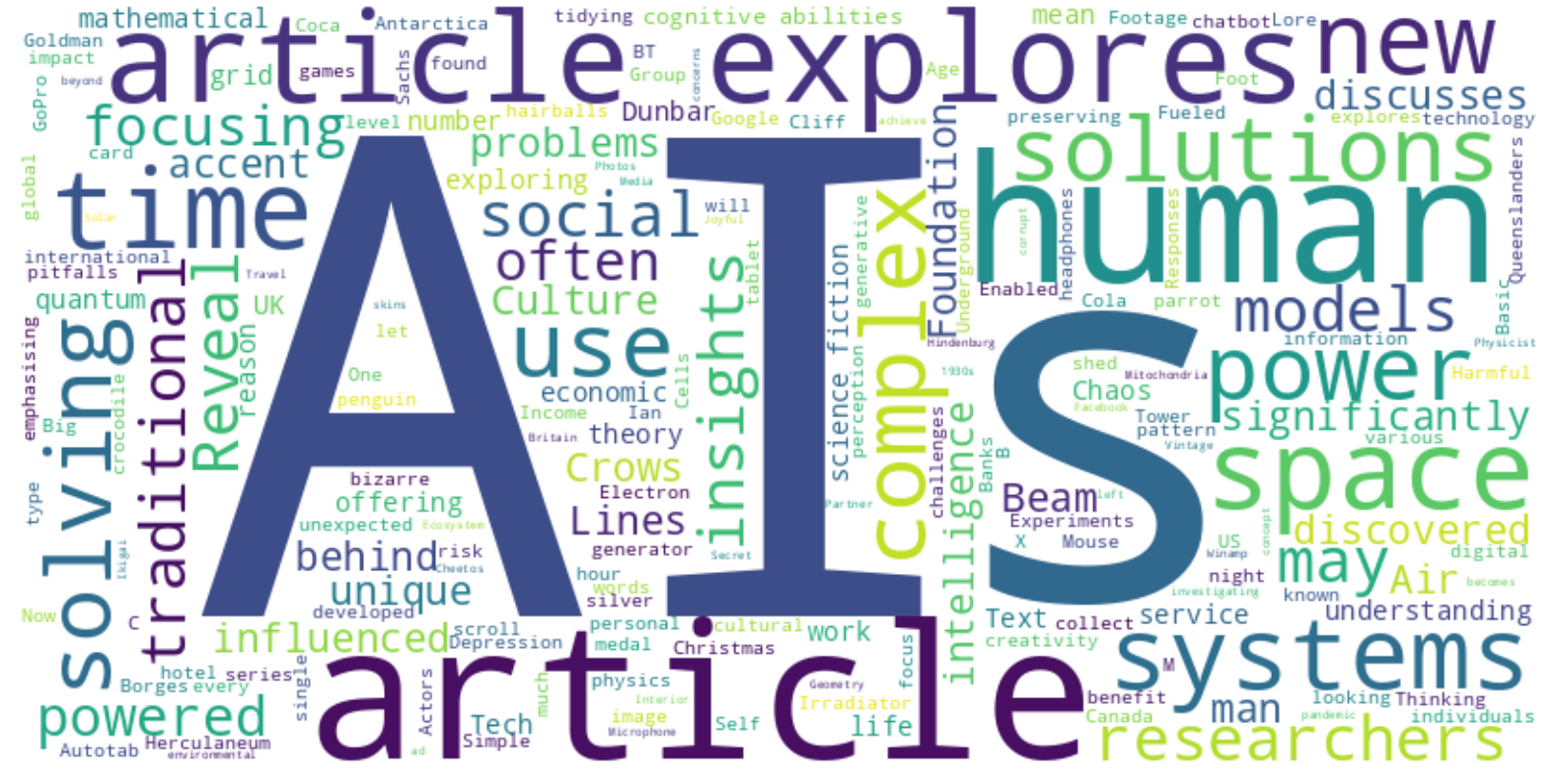
Finally, here's a word cloud based on the titles and summaries of each of the articles. It's pretty obvious the role that AI has played in the global consciousness (at least it is channelled through my head) for 2025:

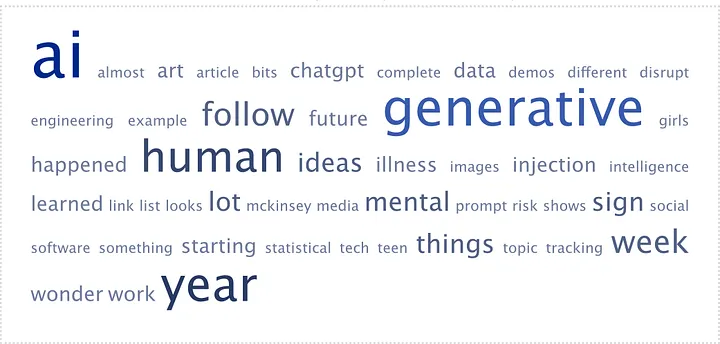
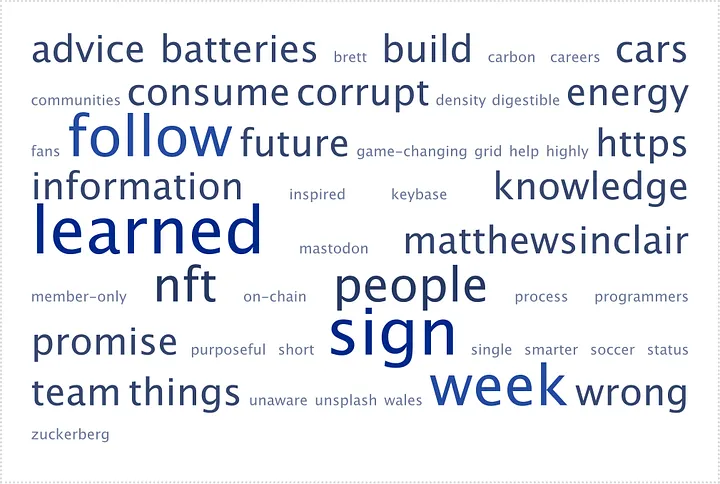
For comparison, here are the word clouds for 2024, 2023 and 2022.
Regards,
Originally posted on matthewsinclair.com and cross-posted on Medium.
[ED: If you'd like to sign up for this content as an email, click here to join the mailing list.]